
1.INTRODUCTION
Turbidimetry is a form of test which is used to measure the concentration of suspended particles in a solution using the assistance of the obscuration of an illumination device in its course via the sample. It is based on the fact that the light is scattered or absorbed by particles of a solution due to which less light is actually sent to a detector. The more the particles, the more the turbidity and less illumination light is transmitted. [1]
Law of Turbidimetry Turbidimetry: the BeerLambert law, that provides the relationship between the decreases of the light and the combination of the department and the concentration and the way length of the liquid: 𝐴 = log ( 𝐼 0 𝐼 ) = 𝑘 𝑐 𝑙 A=log( I I 0 )=kcl Where:
A = absorbance 𝐼 0
the intensity of an incidence light
𝐼 = transmitted radiated light k=constant of turbidity
𝑐 =particles concentration
L= the distance of the path of light in the sample
One application of photodetectors is in turbidimetry where a photodetector is placed at an out of phase angle of 180o relative to the shape of the light. [2]
3.Mechanism of Analyte by turbidimetric technology
Sample Preparation:
Suspended particles preparation of sample is done.
Light source:
Monochromatic light source is applied (usually a tungsten lamp or an LED lamp) through the sample
Scattering and Absorption:
It scatters and absorbs the light by the particles of the light in the solution.
Detection:
The light that was not absorbed is detected at 180 o to incident beam.
Data Analysis:
Turbidity is determined by measuring the decrease in the light which is related to the concentration of the particles. [3]
Instrumentation of Turbidimetry
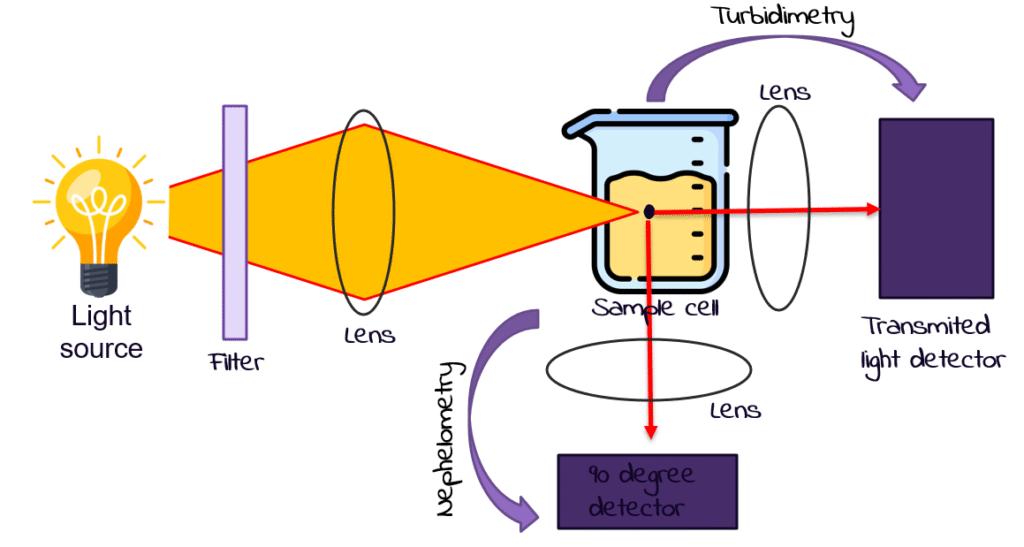
There will be, under the ordinary turbid metric machine, a vertical hole, of the shape of a coffee pot, which descends through the fills.
Lamp, Light, Bubbo, Tungsten, Lamp.
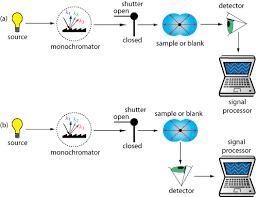
Through Collimating Lens, beam is directed with the help of focus lens photodetector crash ee ee eighty-one eighty is also termed as making (informal inter; – analog/ digital meter) The substitutes to it are Nephelometry and Turbidimetry.
Differences between turbidimetry and nephelometry
It was used to monitor the precipitation in drug formulae and suspensory quality control on suspensory.
It is used in the observation of precipitation with formulas of drugs, and in the suspension suspensory quality control. Turbidimetry plays a very significant role in water pollution monitoring as environmental departments and agencies make use of turbidimetry in determining the degree of water pollution due to the presence of organic and inorganic matter. [6]
2. Pharmaceutical Industry
It was used to monitor the precipitation at the formulas of the drugs and the
suspensory control of suspension. [7]
3. Clinical Diagnostics
It is used to determine the amount of proteins such as CRP (C-reactive protein), immunoglobulins, etc. in the blood serum by means of measuring antigen-antibody complexes in immunoturbidimetry. [8]
4.The food industry of the Metal Beverage Food
Follows liquids that are transparent like beer, wine and juices. The turbidity gives an indication of the contamination by either microbial or particles. [9]
5. Microbiological Assays:
It has been used in microbiology as a way of estimating the growth of a bacterial population based on media turbidity. Optical density is associated with the ability of the microbial cell to increase its density. [10]
7. The Advantages of the Turbidimetry
- Gravity of being (easy) The former, which is really quicker (gravity of being)
- Non-destructive Cost-effective
Limitations
- Also, there aplasia of nephelometry led to insensitiveness of direction
- The shape and size have the ability to change the accuracy of the particle.
- There is a requirement of cuvettes, calibration cuvettes and clean cuvettes